22 May, 2026
Friday
BLOG
DeepSeek V4 and OpenClaw: My AI Agent Breakthrough With Multi-LLM Self-Auditing
Why This Week Changed the Way I Use AI
This week has been one of the most important weeks in my AI journey so far.
For the last two years, I have been building, testing, breaking, repairing, and improving my own AI automation systems. A major part of that work has involved OpenClaw, AI agents, API integrations, software audits, server inspections, social media automation, information gathering, and internal business workflows.
Until recently, much of my progress was built using the OpenAI API. OpenAI has been extremely useful and has helped me get much further than I could have imagined only a short time ago. Without access to strong commercial AI models, I would not have been able to develop the level of automation, testing, and internal AI support that I now use across several of my projects.
However, I have also been dealing with two serious practical problems.
The first problem is cost. Running AI agents through API credits can become very expensive very quickly. Depending on the level of testing, coding, inspection, and automation being performed, API usage can easily cost USD $50 to USD $100 per day. For a business owner using AI seriously every day, that becomes a real operational cost.
The second problem is harder to see but even more important. Some of the bugs, setup mistakes, and unfinished logic I was finding in my OpenClaw installation appeared to be caused not only by the software itself, but also by the quality and behaviour of the LLM being used to inspect, write, or advise on the system.
In simple terms, the AI was helping me move forward, but it was also missing things.
Sometimes it would overlook basic setup mistakes. Sometimes it would accept legacy code as normal. Sometimes it would give a confident answer without fully checking the environment. Sometimes it would focus on the wrong file, the wrong service, or the wrong assumption.
That does not mean the model was useless. It means that one model, working alone, should not be treated as the final authority when dealing with complex systems.
The Breakthrough: DeepSeek V4 Inside My OpenClaw Workflow
The breakthrough came after I started testing DeepSeek V4 inside my OpenClaw workflow.
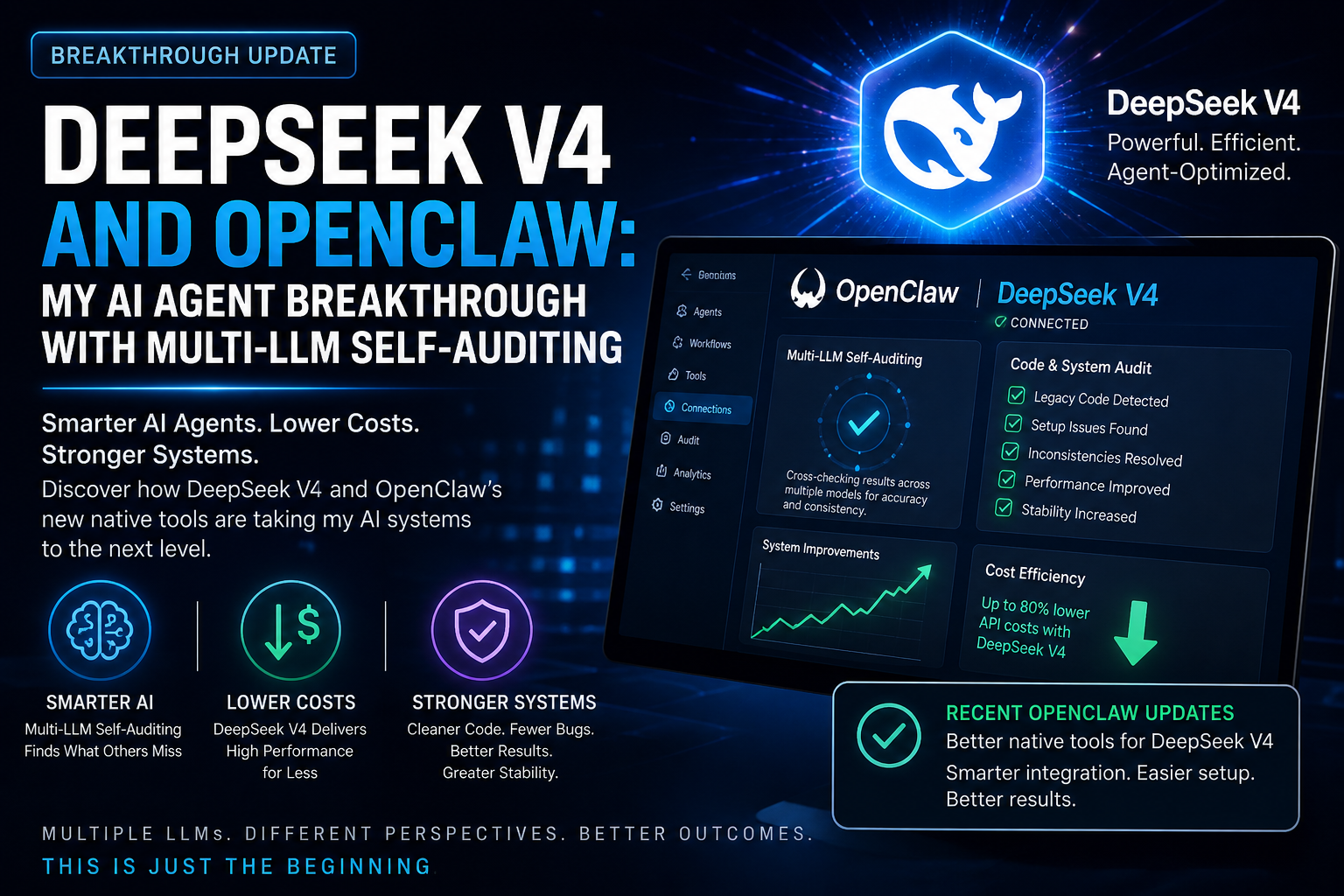
DeepSeek V4 introduced new model options, including V4-Pro and V4-Flash, with API compatibility designed to make migration easier for existing AI agent setups. Just as importantly, recent OpenClaw updates now include better native tools and model-provider handling for using DeepSeek V4 directly inside OpenClaw workflows. This reduces the need for custom workarounds and makes it easier to test DeepSeek V4 as part of a practical AI-agent stack.
For my own testing, the important point was not just that DeepSeek V4 could be connected. The important point was what happened after I started using it.
My OpenClaw AI agents began to behave differently.
They were not just cheaper to run. They were looking at problems differently.
When I used DeepSeek V4 to inspect some of the same code, configuration, and OpenClaw setup issues that had already been reviewed by other models, it started finding inconsistencies that had previously been missed.
That was the moment when the real lesson became clear.
Different LLMs do not think in exactly the same way. They do not all prioritise the same risks. They do not all notice the same mistakes. They do not all explain problems with the same level of directness or technical focus.
One model might be better at explaining a concept. Another model might be better at finding a configuration mistake. Another might be stronger at code review. Another might be more useful for planning, documentation, or business writing.
The mistake is assuming that one AI model should be used for everything.
Multi-LLM Self-Auditing Is Now Part of My AI Strategy
What I am now doing is much more powerful.
Instead of relying on a single LLM to inspect my systems, I am beginning to use multiple LLMs as part of a self-auditing process.
The process is simple in principle:
-
One AI model reviews the system, code, or configuration.
-
A second model checks the first model’s conclusions.
-
A third model may be used to look specifically for omissions, risks, legacy mistakes, or weak assumptions.
-
The findings are compared before changes are made.
-
Any high-risk change still requires human approval.
This has already started producing better results.
By comparing outputs from different models, I have been able to identify old code, old assumptions, incomplete setup work, and mistakes that were not being clearly highlighted before. This is especially useful for systems that have evolved over time, where legacy files, old scripts, previous developer choices, and unfinished refactoring can create confusion.
In my case, this has helped improve my OpenClaw installation, my AI agent workflows, and several associated software projects.
The system is becoming more stable. The results are becoming more useful. The reports are becoming clearer. The agents are becoming better at identifying what matters and what needs to be fixed.
AI Agents Should Not Rely on One Model Alone
One of the biggest lessons I have learned is that AI systems should be tested by more than one AI.
A human developer can miss things. An AI model can also miss things. But when multiple models are asked to inspect the same problem independently, the combined result can be much stronger.
This is especially important when using AI agents that are connected to real business systems, servers, files, websites, social media tools, or customer-facing software.
An AI agent should not simply be trusted because it gives a confident answer. It should be tested, audited, compared, and improved.
This is the same principle we already use in business, finance, legal work, compliance, and software development. We do not rely on one unchecked opinion for important decisions. We review, verify, compare, and confirm.
AI should be treated the same way.
Cost Changes What Is Possible
The cost difference is also significant.
When API usage costs USD $50 to USD $100 per day, you naturally become careful about how often you run checks. You may avoid retesting. You may avoid deeper audits. You may reduce the number of times you ask the system to inspect itself.
But when lower-cost models provide useful coding, inspection, and reasoning output, more frequent testing becomes realistic.
That is a major change.
Lower-cost LLMs make continuous AI inspection more practical. They make it possible to run more checks, compare more outputs, review more code, and build smarter internal automation without constantly worrying about burning through API credits.
For my own systems, that changes the equation.
The question is no longer simply, “Can AI do this?”
The better question is, “Which AI model should do this, and which other model should check the answer?”
May 2026 Feels Like a Turning Point for AI Automation
It is now May 2026, and the pace of AI development is extraordinary.
New models are being released quickly. Agent frameworks are improving. Context windows are getting larger. Coding ability is improving. Model pricing is becoming more competitive. Open-source and open-weight models are becoming more serious alternatives to closed commercial systems.
For people who have been working with AI for the last two years, the difference is obvious.
The results we are getting today are not the same results we were getting six months ago. In many cases, they are not even the same results we were getting three months ago. Sometimes, even tests from a few weeks ago need to be repeated because the model capability, pricing, integration options, or reasoning quality has changed.
That is why I believe many people need to rethink their assumptions about AI.
If you tried to build something with AI in the past and it did not work, that does not mean it will not work now.
If an AI agent failed six months ago, it may now succeed.
If a workflow was too expensive three months ago, it may now be affordable.
If a model missed bugs last month, another model may now find them.
If a system felt unreliable before, it may be worth testing again with a better model, a better prompt, a better agent framework, or a multi-model review process.
My Advice: Retest Everything You Tried With AI
My strongest advice to anyone working with AI is this: retest your assumptions.
Do not assume that a failed AI experiment from last year is still impossible.
Do not assume that one LLM represents all AI capability.
Do not assume that the most famous model is always the best model for every task.
Do not assume that a confident AI answer is correct.
And do not assume that the workflow you tested a few months ago will produce the same result today.
AI is moving too quickly for old conclusions to remain reliable.
For my own work, the breakthrough has been clear. By using multiple LLMs to inspect, compare, and audit my OpenClaw systems, I am getting better results, finding more problems, reducing costs, and improving the stability of my automation stack.
This is not just about one model replacing another.
It is about changing the way we use AI.
The next stage is not simply asking one AI for an answer. The next stage is building systems where multiple AIs can challenge, audit, improve, and verify each other, with a human still making the final decision on important changes.
That is where I believe AI automation is heading.
And this week, for the first time, I have seen clearly how powerful that approach can be.
Key Takeaways
-
OpenClaw became more useful for me when I started testing it with more than one LLM.
-
Recent OpenClaw updates have improved native support for using DeepSeek V4 inside AI-agent workflows.
-
DeepSeek V4 produced different and useful results when reviewing my AI agent setup.
-
Multi-LLM self-auditing helped expose legacy code, old assumptions, and configuration mistakes.
-
Lower-cost models make frequent AI system checks more practical.
-
AI results are changing so quickly that old conclusions from six months ago may no longer be valid.
-
The future of AI automation is not one model giving one answer. It is multiple models checking, challenging, and improving each other.
FAQ
What is the main lesson from testing DeepSeek V4 with OpenClaw?
The main lesson is that different LLMs can find different problems. Using more than one model to review the same AI agent system can expose mistakes, weak assumptions, and legacy issues that a single model may miss.
Why does multi-LLM auditing matter?
Multi-LLM auditing matters because no AI model is perfect. One model may be strong at coding, another may be better at configuration review, and another may be better at documentation or risk analysis. Comparing their outputs can create a stronger review process.
Why do OpenClaw native tools matter for DeepSeek V4?
Native OpenClaw support matters because it makes DeepSeek V4 easier to use inside real AI-agent workflows. Instead of relying heavily on custom integrations, OpenClaw can now handle DeepSeek V4 more directly through improved model-provider and tool-handling support. This makes testing, switching, and comparing models more practical.
Is DeepSeek V4 better than OpenAI?
I do not see this as a simple question of one model being better than another for every task. My experience is that different models have different strengths. The real breakthrough is using multiple models together and choosing the right model for the right job.
Why should people retest old AI workflows?
AI models, APIs, pricing, context windows, agent tools, and reasoning quality are improving very quickly. A workflow that failed six months ago, three months ago, or even a few weeks ago may now produce a very different result.
What is the future of AI agents?
I believe the future of AI agents is multi-model, self-auditing, and human-supervised. AI systems will increasingly be designed so that one model can perform the work, another can check it, and a human can approve important decisions.
Recent News